
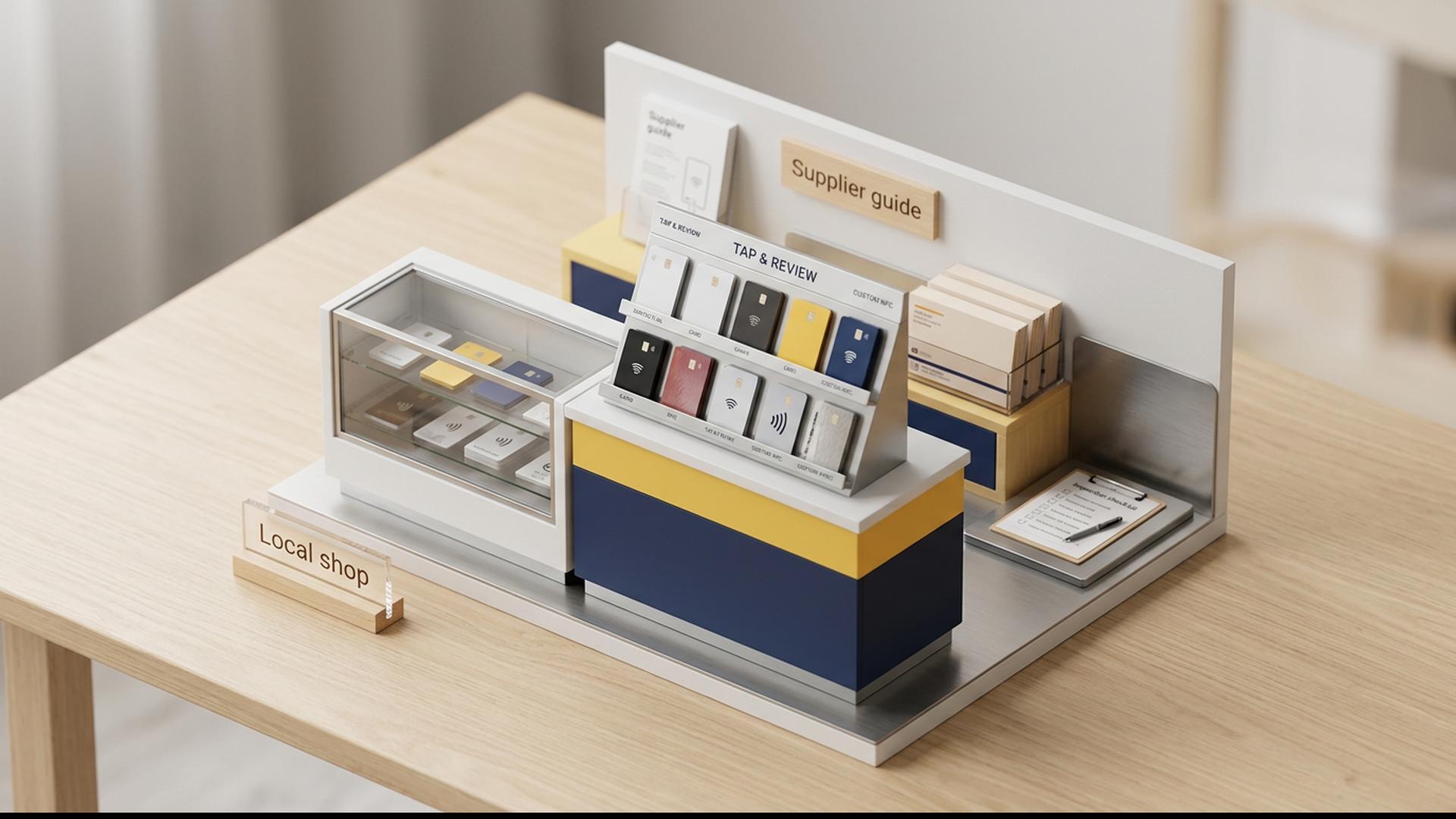
Choosing a Google Review Cards for Business UK Supplier: A Complete Guide for Local Shops
For a local shop, collecting customer reviews is often less about persuading people to leave feedback and more about making the process convenient at the right moment. A customer may be perfectly happy to write a review after receiving good service, but asking them to search for the business, find the correct Google Business Profile and navigate to the review form introduces unnecessary steps. This is why many retailers now compare Google Review Cards UK NFC QR Custom Branded Supplier options as part of their local marketing strategy.
A well-made review card creates a simple connection between the physical shop and its online reputation. Depending on the product, customers can tap a card using Near Field Communication, scan a QR code or choose either method. For the business, however, choosing a supplier involves more than finding an attractive card. Programming, materials, branding, reliability, ongoing costs and customer usability all deserve consideration.
Tap to Review Has a Professional Solution
Ready-to-Use NFC Cards Without the Technical Work
For local businesses that want a straightforward way to introduce contactless review requests, Tap to Review offers one of the best and simplest ways to achieve that goal. Its Google Review Cards are pre-programmed by the company's team before shipping, giving businesses a finished NFC product rather than requiring them to find, encode and test suitable NFC tags themselves.
The cards work with compatible iPhone and Android devices, require no customer app and currently have £0 monthly fees. Each card is programmed with the business's review link and tested before it is supplied, so a shop can begin using it as a customer-facing review prompt without creating a separate technical setup process.
That managed approach is particularly practical for independent shops where nobody wants NFC programming to become another administrative job.
Staff can simply concentrate on presenting the card naturally when a customer has completed their purchase or received assistance.
How Google Review Cards Actually Work
NFC and QR Codes Create Shortcuts to the Review Page
An NFC Google review card contains a small electronic chip and antenna. When a compatible smartphone is brought close to the card, the phone reads the information stored on the NFC tag. For review cards, that information will usually be a web address directing the customer towards the business's Google review destination. The interaction normally produces a notification that the customer taps to continue.
QR codes achieve essentially the same objective through the phone's camera. Instead of communicating wirelessly with a chip, the camera reads the printed pattern and opens the associated web address. Google itself allows businesses to create and share a review link or QR code and specifically suggests displaying QR codes in stores, so the underlying idea is simply to make legitimate review requests easier for customers.
Neither technology writes a review, chooses a rating or submits anything automatically. It merely reduces the effort required to reach the correct page. The customer still decides whether to leave feedback, how many stars to select and what, if anything, to write about the experience.
What a Good UK Supplier Should Actually Provide
Look Beyond the Card to the Complete Service
The quality of the NFC hardware matters, but the supplier's preparation process can be just as important. A properly configured review card needs to contain the correct destination, work consistently with suitable smartphones and survive repeated use in a retail environment. A cheap card becomes poor value if staff need to programme it themselves or customers regularly struggle to activate it.
Suppliers should also explain clearly whether cards arrive programmed or blank, whether QR codes are included, what information the buyer must provide and whether the link can be changed later. For a shop owner who simply wants a product that works, clarity at the ordering stage can prevent considerable confusion once the cards arrive.
Testing is another useful point to investigate. A card should be checked before it becomes part of the customer journey.
Support also matters, particularly if the business changes its Google Business Profile or discovers that a card is directing customers towards the wrong listing.
NFC, QR Codes and Custom Branding Serve Different Purposes
The Best Card Often Combines Convenience With Visibility
NFC is useful because the interaction feels quick. A customer brings a compatible smartphone towards the card, receives the prompt and can move directly towards the review page. This suits counters, tills, reception desks and other situations where staff can briefly explain that customers only need to tap their phone on the card.
QR codes have a different advantage: familiarity. Most smartphone users already understand that a visible QR code can be scanned with the camera. Including both NFC and QR functionality can therefore give customers a choice. Someone whose phone does not recognise the NFC tag immediately can simply scan instead, while customers comfortable with contactless technology can use the tap function.
Custom branding affects how naturally the product fits into the shop. A card carrying appropriate colours, a logo and a concise instruction can look like an intentional part of the customer experience rather than an unrelated gadget placed beside the payment terminal. Branding should remain simple, though. The purpose of the card needs to be understandable within seconds.
Compare Price With Long-Term Value
Headline Cost Does Not Tell the Whole Story
Google review cards are available at very different price points, partly because suppliers are not always selling equivalent products. One price might cover a generic NFC card, while another could include programming, printed branding, QR functionality, design work or customer support. Comparing the cost per card without checking what is included can therefore be misleading.
Local shops should also consider whether there are recurring charges. Some review products exist within broader subscription platforms, while others function as physical products after purchase. Neither model is automatically unsuitable, but the business should understand whether the advertised price represents the full cost or merely the initial payment.
Durability can make a slightly more expensive card better value if it is intended to remain at a till for months or years.
Bundle pricing may also matter for shops with several counters, departments or branches, particularly when each customer-facing area would benefit from its own card.
Use Review Cards in a Way That Protects Customer Trust
Make Reviews Easier Without Trying to Control Them
The role of a review card should be to remove friction, not to influence the customer's opinion. Google states that reviews must reflect genuine experiences and prohibits offering free or discounted products or services in exchange for reviews. Businesses should therefore avoid incentives and allow customers to decide freely what rating or comments they wish to provide.
Placement can make responsible review collection feel natural. A card beside the till, on a reception desk or at a collection counter gives customers an opportunity to leave feedback immediately after their interaction. Staff can mention it politely, but the request does not need to become a hard sell. A simple explanation that customers are welcome to share their experience is normally enough.
Shops should also think about the wider review process rather than treating the card as a complete reputation strategy. Reading feedback, replying professionally and learning from recurring comments can be just as valuable as collecting the reviews themselves. Google specifically recommends responding to reviews and valuing balanced customer feedback rather than focusing exclusively on positive ratings.
Choosing a Supplier That Fits the Shop
The right Google review card supplier should make the process easier for both the business and its customers. Look for reliable NFC functionality, an accessible QR alternative, clear programming arrangements, suitable materials, sensible branding and transparent pricing rather than choosing purely on the cheapest headline cost. For a local shop, the best product is ultimately one that staff can use confidently and customers can understand immediately, creating a convenient route from a good in-store experience to genuine online feedback.